
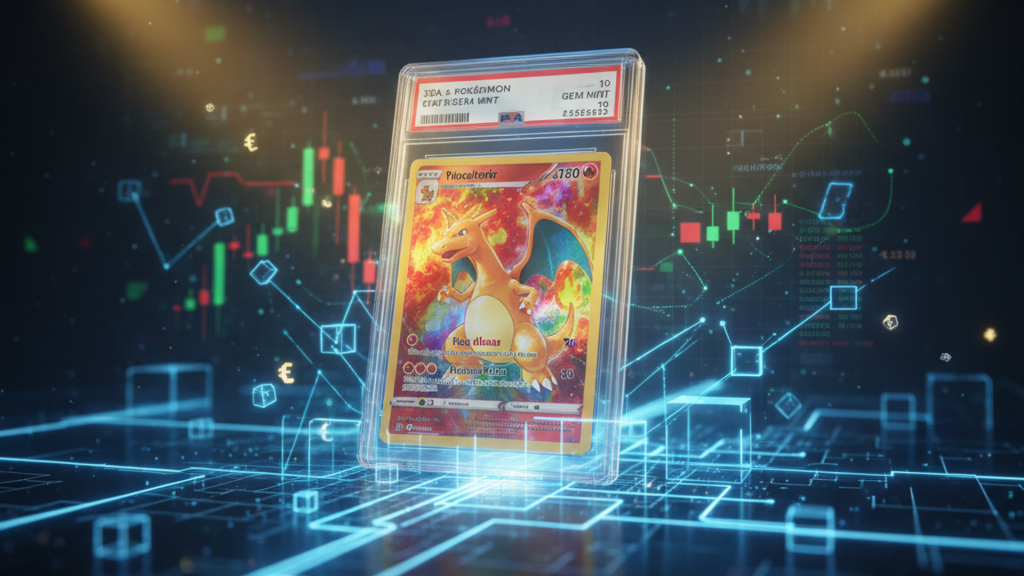
The $8B on-chain TCG market
The traditional trading card game (TCG) industry is a massive, established sector, valued between $8 billion and $10 billion globally with a steady 8% annual growth rate. This market size places physical collectibles on par with the sneaker industry and just below luxury watches. For decades, this value was locked behind physical barriers: storage, shipping, and authentication. TCG on-chain assets are now dismantling those barriers, moving billions in value onto public ledgers where liquidity is instant and ownership is verifiable.
While the physical market remains the dominant force, the on-chain segment is growing at a pace that outstrips the traditional sector. Current data indicates that transaction volume in the on-chain TCG market has reached approximately $630 million. Although this represents only about 8% of the total addressable market, it signals a rapid shift in how collectors and investors engage with digital collectibles. The on-chain model is not replacing physical cards entirely but is capturing a significant, high-growth slice of the broader economy.
The convergence of these two worlds creates a unique investment landscape. On-chain assets offer fractional ownership, programmatic scarcity, and seamless global trading, addressing the inefficiencies that have long plagued physical TCG markets. As institutional interest grows and infrastructure matures, the gap between the physical and digital valuations continues to narrow, establishing TCG on-chain assets as a critical component of the modern collectibles economy.
TCG on-chain assets explained
Tokenized trading cards are digital counterparts to physical collectible cards, issued as cryptographic tokens on a blockchain. This shift creates TCG on-chain assets that exist either as pure digital collectibles or as digital twins of physical items. The core value proposition is verifiable ownership and authenticity, recorded immutably on the ledger.
Pure digital TCG on-chain assets are created natively on the blockchain. They have no physical equivalent. These assets trade solely in digital marketplaces, leveraging smart contracts to manage rarity, royalties, and transfer history. Their value is derived entirely from community demand and scarcity protocols.
Tokenized physical assets, often called "phygital" cards, bridge the physical and digital worlds. A physical card is secured or paired with a non-fungible token (NFT). The token serves as a certificate of authenticity, providing onchain proof of ownership and condition. This model allows collectors to verify provenance instantly while retaining the tactile appeal of the physical card.
The distinction matters for liquidity and utility. Pure digital assets offer instant settlement and global accessibility. Tokenized physical assets provide a layer of security for high-value collectibles, reducing fraud and enhancing trust in the secondary market.
Key platforms driving adoption
The $8 billion shift in TCG on-chain assets is being driven by a handful of protocols that bridge the gap between physical collectibles and digital liquidity. While the total on-chain transaction volume currently sits around $630 million—representing roughly 8% of the broader TCG market—the growth trajectory is steep. Platforms are moving beyond simple NFT minting to create real-world utility, allowing collectors to trade, insure, and finance physical cards with unprecedented speed.
Collector Crypt
Collector Crypt has emerged as a primary engine for this transition, specifically by tokenizing physical trading cards on the Solana blockchain. The platform focuses on high-value, graded cards, linking the digital token to the physical asset held in secure custody. This model allows traders to capture the positive expected value (EV) of rapid secondary market turnover without the logistical delays of traditional shipping. By enabling instant settlement, Collector Crypt is redefining how capital moves through the collectibles market.
Pokémon TCG World
Conversely, Pokémon TCG World represents the digital-native side of the TCG on-chain assets ecosystem. Rather than tokenizing physical inventory, this platform facilitates the trading and management of digital card assets within the Pokémon universe. The recent launch of CARDS on Solana has sparked a flurry of trading activity, demonstrating that digital scarcity and community-driven economies can sustain significant volume. This platform appeals to a different demographic, prioritizing accessibility and instant gameplay over physical ownership.
Platform Comparison
The divergence in strategy highlights two distinct paths for TCG on-chain assets. Collector Crypt targets the high-net-worth collector seeking liquidity for physical assets, while Pokémon TCG World targets the broader player base seeking digital utility. Understanding which model aligns with your investment or collection goals is essential for navigating this emerging market.
| Platform | Asset Type | Primary Utility |
|---|---|---|
| Collector Crypt | Physical (Tokenized) | Liquidity & Trading |
| Pokémon TCG World | Digital Native | Gameplay & Collection |
From static collectibles to functional gaming assets
The narrative around TCG on-chain assets is shifting from speculative holding to active utility. Early adopters treated digital cards as digital art, but the underlying technology now supports complex game logic. This evolution transforms the asset from a passive image into a playable component with verifiable history.
Play-to-earn mechanics
Blockchain enables true ownership of in-game economies. Unlike traditional digital collectibles where the publisher controls the database, TCG on-chain assets allow players to prove ownership and trade freely. This structure supports play-to-earn models where value is generated through gameplay rather than mere scarcity. Players can monetize their skills and time, creating a sustainable economy that rewards active participation over passive speculation.
Verifiable condition tracking
Physical trading cards suffer from wear, tear, and counterfeiting. Digital versions eliminate these physical risks while introducing new verification standards. Smart contracts can track a card’s condition, usage history, and authenticity in real time. This transparency reduces fraud and increases trust in secondary markets.
Integration with game engines
Modern TCG on-chain assets are increasingly integrated directly into game engines. This allows for dynamic card modifications, such as power-ups or temporary buffs, that are recorded on the blockchain. These features create a more immersive experience, bridging the gap between traditional tabletop strategy and digital innovation. The result is a hybrid model that preserves the strategic depth of physical play while leveraging the efficiency and security of blockchain technology.
Market outlook and risks
The trajectory for TCG on-chain assets points toward significant expansion, though the current landscape remains a fraction of the total addressable market. Industry analysis suggests the broader TCG sector is an $8–10 billion global market, growing at an 8% compound annual rate. Within this ecosystem, on-chain transactions currently account for approximately $630 million, or roughly 8% of the total volume. This disparity highlights a substantial opportunity: the on-chain segment could capture an additional $2 billion in market value as digital integration matures.
However, this growth is not without friction. Regulatory uncertainty remains the primary headwind. As these assets bridge traditional collectibles with decentralized finance, they face evolving compliance requirements that vary by jurisdiction. Investors must navigate a landscape where the legal status of digital collectibles is still being defined, creating potential volatility unrelated to market demand.
Liquidity risk is the second major concern. Unlike traditional physical cards with established auction houses, TCG on-chain assets rely heavily on decentralized exchange depth. In times of market stress, slippage can be severe, and exit liquidity may dry up for lower-tier assets. This illiquidity premium means that while the upside potential is high, the cost of trading—both in fees and price impact—can erode returns for active participants.
To gauge the broader market sentiment influencing these assets, it is useful to monitor major crypto indices, as TCG tokens often correlate with overall blockchain activity.
The path forward requires balancing innovation with caution. While the $2 billion opportunity is real, it demands rigorous due diligence on both the underlying asset quality and the regulatory environment. Investors should approach this space as a high-risk, high-reward segment of the digital economy, where long-term value depends on sustained adoption rather than speculative hype.
No comments yet. Be the first to share your thoughts!